
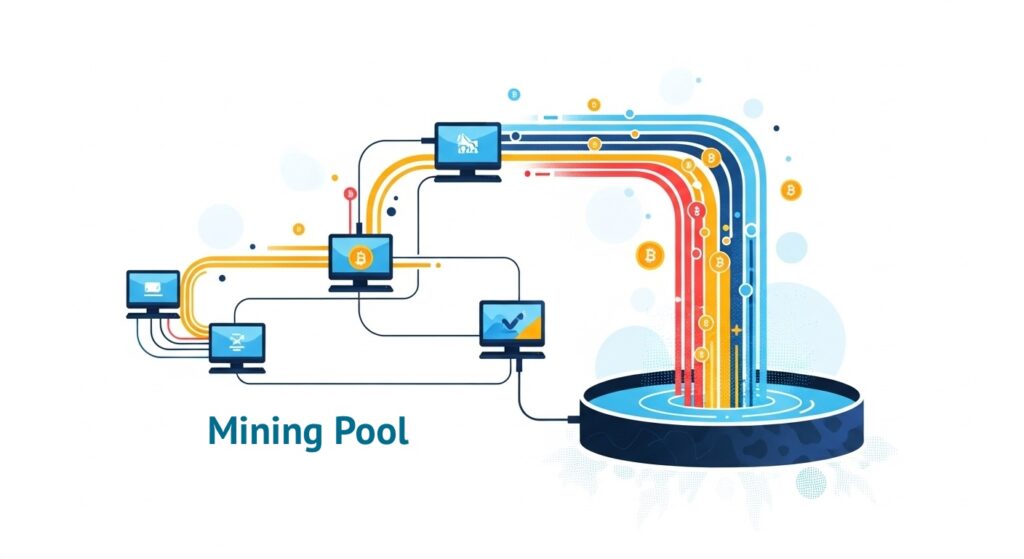
Once upon a time, Bitcoin was mined on ordinary CPUs, but today, even powerful ASIC farms rarely find blocks on their own. Mining pools solve this problem by combining the power of thousands of participants.
Running an ASIC in solo mode is like trying to win the national lottery by buying one ticket a year. Theoretically possible, but in practice, almost hopeless. A mining pool is your team, combining the power of thousands of similar ASICs to guarantee sharing the winnings every day.
This is not just a convenience, but an absolute industry standard, without which 99% of farm owners would never see a stable profit. In this guide, we will break down all the mechanics of pools – from how they work, to the types of payment schemes, and how to choose a reliable pool.
Table of Contents:
- 1. The Problem of Solo Mining: Why It’s Almost Impossible Alone
- 2. What is a Mining Pool in Simple Terms?
- 3. How it Works: Mechanics Under the Hood
- 4. Reward Systems: How Do Pools Share Money?
- 5. Pros and Cons: An Honest Look
- 6. How to Get Started: First Steps in the World of Pools
- 7. Conclusion: The Pool is the Standard for ASIC Mining
1. The Problem of Solo Mining: Why It’s Almost Impossible Alone
Mining solo today is a venture for industrial giants with their own data centers. And here’s why: the network difficulty of most cryptocurrencies is so high that the power of one, ten, or even an entire rack of ASICs is a drop in the ocean.
Your farm can operate for months, and you’ll never find the correct solution (block). All your hashrate, all the electricity spent—for nothing. This is a game with colossal variance, where you can wait an eternity for a reward. Pools solve precisely this problem.
2. What is a Mining Pool in Simple Terms?
A mining pool is a server that combines the computational power (hashrate) of thousands of ASICs and farms from all over the world into one giant virtual machine. Instead of competing with each other, they (miners) combine their computational power (hashrate) and jointly search for blocks.
The goal is simple: together, find a block faster than anyone else. When a pool finds a block, it receives a reward from the network (e.g., N-number of BTC) and distributes it among all participants proportionally to their contribution.
Instead of one elusive reward every few years, you get small but stable and predictable payouts every day.
3. How it Works: Mechanics Under the Hood
If you dig deeper, the process looks like this:
- Shared Power Pot. You connect your ASIC or farm to the pool’s address by entering it in the settings. Your hashrate merges with the hashrate of other participants.
- Tasks from the Pool and “Shares”. The pool receives a complex overall task from the cryptocurrency network – to find a block. It, in turn, breaks this task into millions of simpler subtasks and distributes them to the participants’ ASICs. When your ASIC solves such a subtask, it sends proof of work – a “share” – to the pool.
- What is a Share? This is not the block itself. A share is cryptographic proof that your ASIC is working honestly and contributing to the overall search effort. The more shares you’ve sent, the larger your stake in the common endeavor.
- Block Found and Reward. Sooner or later, one of the millions of shares sent turns out to be that “golden ticket” – the correct solution for the entire block. The pool announces the discovery, receives the reward from the network, and distributes it among everyone who sent shares.
4. Reward Systems: How Do Pools Share Money?
Not all pools distribute rewards equally. The calculation method is a key difference between them. Here are the most common:
- PPS (Pay Per Share): The pool pays you for every share sent, regardless of whether the pool found blocks or not. This is the most predictable, stable income, but it’s usually slightly lower due to the risks the pool assumes.
- PPLNS (Pay Per Last N Shares): Payment occurs only when the pool finds a block. The reward is divided among those who submitted the last N number of shares. This method relies more on luck (“pool’s luck”), but in the long run, it can be slightly more profitable than PPS.
Each system has its nuances that directly affect your final income. We have analyzed them in detail in our separate article:
➡️ Reward Systems in Mining Pools: PPLNS, PPS, FPPS, and Others.
5. Pros and Cons: An Honest Look
| Pros of Pool Mining | Cons of Pool Mining |
|---|---|
| ✅ Stable and predictable income. You receive money regularly. | ❌ Commission. The pool takes a small percentage (usually 0.5-2%) for its services. |
| ✅ Low barrier to entry. You can start with even one ASIC. | ❌ Centralization. Large pools control a significant portion of the network’s hashrate. |
| ✅ Simplicity. No need to set up your own network node and complex software. | ❌ Server dependency. If the pool has technical problems, your mining will be idle. |
Want to compare these two approaches in more depth? We have provided a direct comparison:
➡️ Solo Mining vs. Pool Mining: What to Choose and Why?
6. How to Get Started: First Steps in the World of Pools
Connecting to a pool involves two key steps:
- Choose the right pool. Evaluate commissions, ping to servers, reputation, and payment system. This is the most important decision.
- Configure your ASIC. Access your ASIC’s web interface and enter the pool server addresses (URL), your login (worker), and password.
Both of these steps require careful attention. To help you, we have prepared two detailed guides:
- ➡️ How to Choose a Mining Pool: Ranking the Best for ASICs in 2026.
- ➡️ How to Connect an ASIC to a Mining Pool: Step-by-Step Instructions.
If you have more than 1-2 ASICs and your farm requires constant attention, custom firmware and farm management software will help.
7. Conclusion: The Pool is the Standard for ASIC Mining
For the vast majority of ASIC owners, the question of “solo or pool?” is moot. If you don’t have your own data center, your only path to stable income is through a pool.
This is not a compromise, but a reasonable and the only correct standard for deriving predictable profits from your equipment. Choose a reliable pool, configure your ASICs, and receive a share from every block found.
